
 8 September 2026
 31
31The modern manufacturing landscape is defined by constant evolution. As engineers design increasingly complex, highly optimized components, machine shops are tasked with bringing these intricate geometries to life. Whether a facility is supplying local domestic industries or exporting to rapidly expanding industrial hubs like Dubai, the ability to produce high-precision, multi-sided parts is no longer just an advantage—it is a baseline requirement for industry leadership.
For many production managers and industrial buyers, the challenge lies in expanding factory floor capabilities without disrupting existing workflows. The most effective strategy to achieve this operational leap is through multi-axis integration. By upgrading standard machinery with advanced rotary workholding solutions, facilities can instantly elevate their production capabilities, accept more diverse contracts, and establish a reputation for uncompromising quality.
Moving Beyond the Three-Axis Limit
Conventional Vertical Machining Centers (VMCs) serve as the reliable, foundational backbone for modern manufacturing operations. However, when tasked with producing components that feature intersecting angles, complex curves, or multi-sided features, a traditional three-axis setup quickly reveals its limitations.
In a standard setup, machining a complex part requires an operator to manually unclamp, reposition, and re-clamp the workpiece multiple times to expose different surfaces to the cutting tool. Every manual intervention pauses production, slows down factory throughput, and introduces the risk of handling errors.
To break through this operational ceiling and take on more advanced manufacturing projects, facilities are embracing multi-axis integration. This approach empowers existing machinery to manipulate the workpiece dynamically, completely changing what a shop floor can accomplish in a single shift.
Unlocking Potential with UCAM CNC Tilting Tables
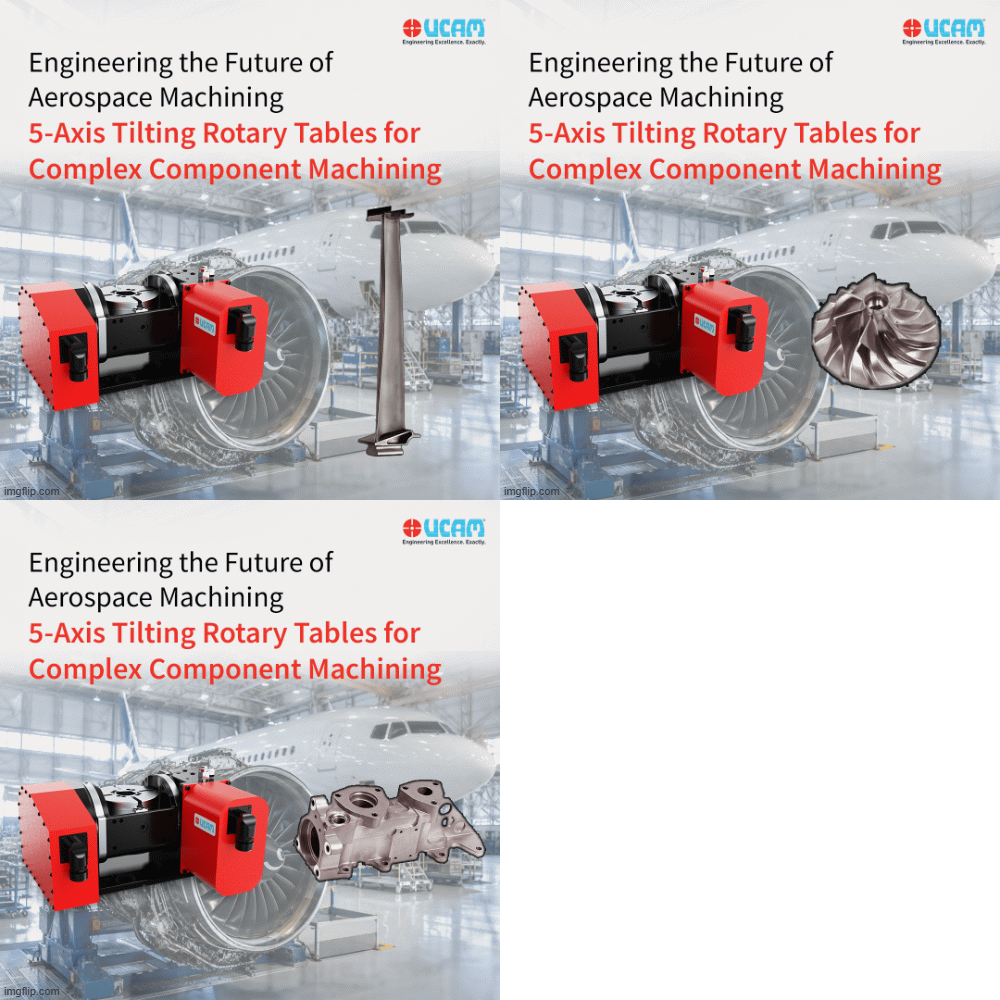
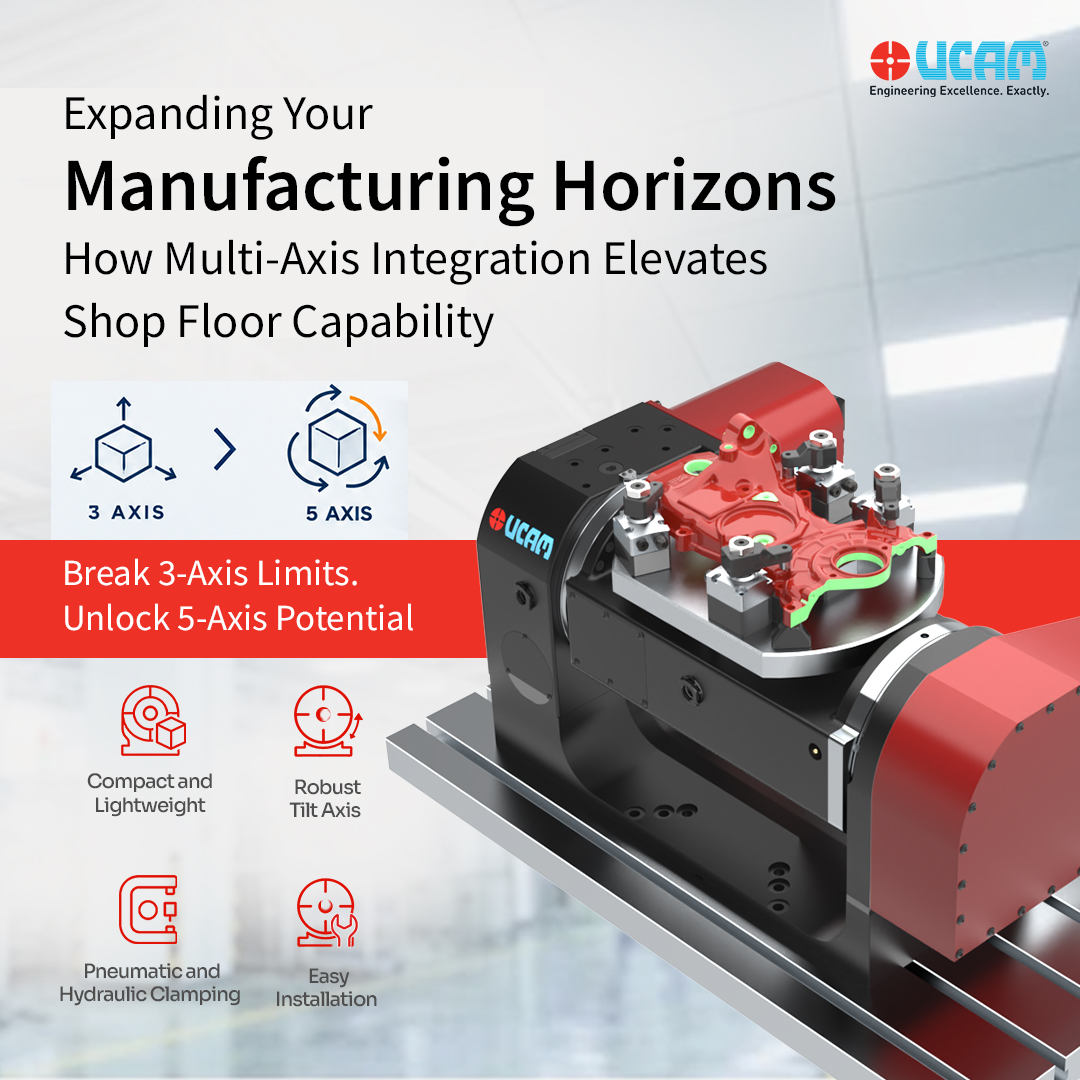
The cornerstone of this manufacturing upgrade is the integration of specialized rotary equipment, specifically 5-axis trunnion systems. By outfitting a standard VMC with UCAM CNC Tilting tables, manufacturers can instantly transform a conventional machine into a highly dynamic, multi-axis production cell.
UCAM CNC Tilting tables operate by providing two additional axes of motion—rotation and tilt. Instead of the operator manually flipping a part, the tilting table securely holds the component and automatically articulates it beneath the machine spindle. This advanced articulation provides the cutting spindle with comprehensive, multi-directional access to five distinct faces of a component within a single, seamless operation.
Such dynamic maneuverability represents a transformative leap in shop floor versatility and production potential.It allows facilities to seamlessly transition from producing simple, flat components to manufacturing the highly contoured, complex geometries demanded by the aerospace, medical, and advanced automotive sectors.
The Operational Impact of Capability Expansion
The adoption of multi-axis solutions transcends simple cutting enhancements; it serves to fundamentally revitalize facility operations and sharpen competitive performance within the international marketplace.
1. Securing High-Precision, Complex Work
The primary advantage of broadening shop floor versatility is a newfound market agility. By integrating CNC Tilting tables, facilities can aggressively pursue sophisticated RFQs that were once beyond their operational scope. Whether fabricating intricate valve housings for energy infrastructure in the Middle East or precision aerospace components for international distribution, multi-axis integration allows your firm to diversify its portfolio and transition into elite industrial sectors.
2. Achieving Operational Flow via “Done-in-One” Processing
Operational throughput is the vital sign of a flourishing manufacturing enterprise. Multi-axis integration facilitates the “Done-in-One” production philosophy. As the tilting table articulates the workpiece to any necessary orientation, various processes—including face milling, deep hole drilling, and complex angular tapping—are finalized in a single, uninterrupted sequence. This optimizes production scheduling, ensuring components progress rapidly from the spindle to dispatch, thereby comfortably meeting the most demanding delivery timelines.
3. Setting the Standard for Precision and Uniformity
For elite manufacturing partners, uncompromising quality is the baseline. Global OEMs require flawless geometric accuracy throughout the entire manufacturing cycle. When production relies on manual repositioning across several setups, maintaining the requisite alignment and dimensional integrity becomes an arduous challenge.
Automated rotary workholding eliminates this variable. Once a part is clamped onto a tilting table, it remains locked in place until it is completely finished. By removing manual handling from the equation, facilities ensure that the thousandth part produced is perfectly identical to the first. This flawless consistency builds deep, long-lasting trust with clients and solidifies your reputation as a premier manufacturing partner.
Empowering Your Shop Floor for the Future
Stepping into a leadership role in the manufacturing sector requires equipment that matches the ambition of your team. Upgrading your existing machinery with advanced rotary technology is a powerful statement of intent.
By integrating solutions like UCAM CNC Tilting Rotary tables, integrating advanced rotary technology signifies more than an equipment acquisition; it represents a commitment to total operational excellence. Adopting multi-axis integration empowers your workforce to achieve peak efficiency, enhances the fundamental integrity of your production, and strategically expands your industrial reach—positioning your facility at the forefront of the sophisticated manufacturing landscape of tomorrow.
FAQs
Can a tilting rotary table do both 3+2 positional indexing and simultaneous 5-axis machining?
Yes. In 3+2 positioning, the table tilts to a set angle and locks solid with hydraulic brakes for drilling or milling flat faces. In simultaneous 5-axis machining, the table rotates and tilts continuously while the tool cuts to sculpt complex 3D contours (like impellers), provided your CNC controller supports multi-axis interpolation.
How do I know if my VMC has enough Z-axis clearance for a tilting table?
Calculate the total stack-up height: the table body, the fixture, the workpiece, and your longest cutting tool. Ensure your machine’s spindle can fully retract above this combined height with enough room to tool-change safely when the table tilts 90 degrees.
How does the CNC machine track part zero when the table tilts?
Modern CNC controllers use Dynamic Work Offset (DWO) or Tool Center Point Control (TCPC). Once the table’s physical center of rotation is calibrated, the controller automatically recalculates the X, Y, and Z coordinates in real time as the table tilts, eliminating manual zero-point resets.


 ucam_marketing