
 18 September 2026
 156
156In today’s highly competitive manufacturing landscape, the ability to produce what others cannot is a significant strategic advantage. While standard multi-axis workholding solutions are sufficient for the vast majority of machine shops, top-tier manufacturers frequently encounter projects that simply defy standard dimensions. Whether machining hyper-specialized flow control valves for the UAE energy sector, fabricating proprietary aerospace structures, or integrating into a highly automated production line, unique geometries require highly specific solutions.
When off-the-shelf equipment reaches its mechanical limit, engineering a custom CNC Rotary Table becomes the strategic key to unlocking flawless production and securing complex, high-margin contracts.
Limitations of Standard Off-the-Shelf Options
Every manufacturing facility operates within its own unique set of physical and operational constraints. Often, the challenge is not just the part itself, but how the part interacts with the machine environment:
- Machine Envelope Constraints: A CNC machine might have heavily restricted Z-axis daylight or tight X-axis travel, meaning a standard rotary system and its motor housing simply will not fit without causing tool collisions.
- Extreme Asymmetry: Some castings feature an exceptionally awkward center of gravity. Mounting these onto a standard faceplate can create dangerous vibration and severely compromise the surface finish.
- Automated Integration: Facilities transitioning into high-volume, “lights-out” production require rotary tables that communicate flawlessly with custom robotic pallet changers, requiring specialized pneumatic and hydraulic porting built directly into the table.
Attempting to force standard equipment to handle these unique challenges usually leads to complex operator workarounds, excessive setup times, and compromised part quality. A custom-built rotary table eliminates these bottlenecks by adapting the workholding to the exact requirements of the workpiece, rather than forcing the workpiece to fit the machine.
Key Areas of Rotary Customization
When collaborating with an application engineering team to build a bespoke rotary table, the level of customization goes far beyond simply changing the bolt pattern on a faceplate. Critical structural and functional modifications include:
1. Bespoke Workholding and Trunnions
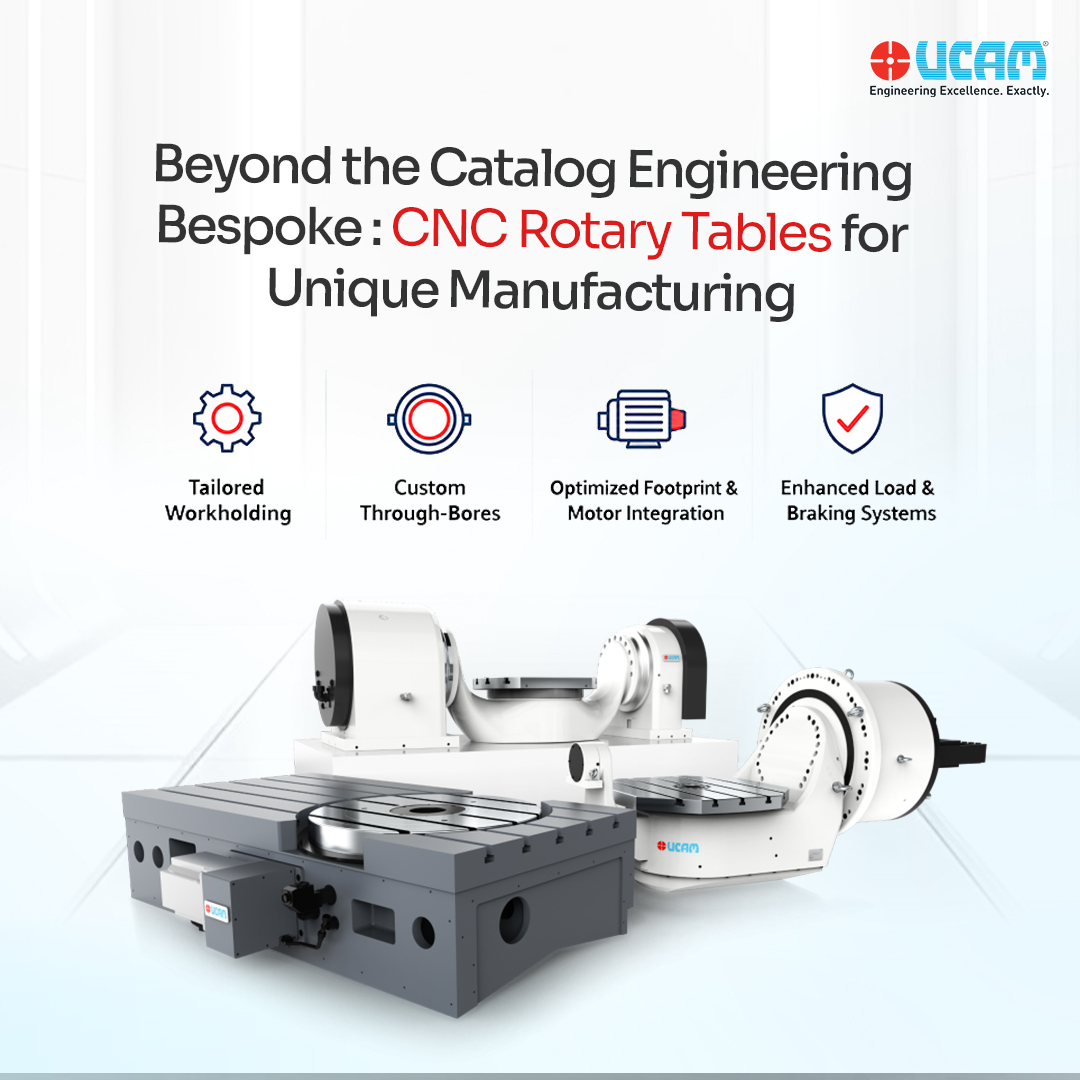
Standard T-slots are highly versatile, but they are not always ideal for high-volume production of irregular parts. Custom engineering allows for the creation of tailored trunnion systems, specialized tombstones, and perfectly matched faceplates designed specifically to cradle awkward, asymmetrical components that demand immediate, repeatable clamping.
2. Tailored Through-Bores
Standard center bores often cannot accommodate oversized drive shafts or specialized internal mechanisms. Custom engineering allows for expanded or specially shaped through-bores. This enables the seamless processing of extra-long structural pipes or allows engineers to route complex hydraulic drawbars directly through the center of the table to automate fixture clamping.
3. Footprint and Motor Integration
For facilities dealing with tight machine enclosures, the physical casting of the rotary table can be modified. Re-engineering the motor mounting position (such as utilizing a fold-back motor design), altering the overall housing profile, or streamlining cable routing ensures the unit fits perfectly inside confined spaces, maximizing the machine’s available cutting area.
4. Advanced Load and Braking Management
For components that generate extreme, directional cutting leverage, the internal mechanics of the table can be upgraded. Custom bearing configurations and reinforced, high-pressure hydraulic braking systems can be specified to absorb massive off-center thrust, guaranteeing absolute rigidity during the most aggressive roughing cycles.
The UCAM Custom Engineering Advantage
Transitioning from a theoretical concept to a fully operational, bespoke rotary table requires a manufacturing partner with deep mechanical expertise and a flexible engineering approach.
UCAM specializes in bridging the gap between standard catalog products and hyper-specific customer requirements. Through their dedicated custom engineering division, UCAM collaborates directly with production managers, manufacturing engineers, and OEM machine builders to design and build bespoke rotary solutions from the ground up.
Whether the project requires engineering a multi-spindle rotary system for a proprietary production line, designing a custom table with a massive through-bore for the oil and gas industry, or modifying the footprint of a standard tilting table for a specialized VMC, UCAM ensures that the final product aligns perfectly with the customer’s operational goals.
By investing in a custom CNC Rotary table tailored to your unique requirements, your facility gains the ultimate operational advantage: the ability to seamlessly execute complex, demanding manufacturing projects that standard machine shops simply cannot touch.
FAQs
What is the typical process for engineering and ordering a custom CNC rotary table?
The process begins with a detailed application review. UCAM’s engineering team analyzes your specific workpiece dimensions, weight distribution, required cutting forces, and the dimensional envelope of your CNC machine. Based on this data, they develop 3D CAD models of the proposed custom table and workholding. Once the design and performance metrics are approved by your team, the unit moves into specialized manufacturing, assembly, and rigorous geometric testing.
Can a custom rotary table be integrated seamlessly into a fully automated robotic cell?
Absolutely. In fact, automation is a primary driver for custom rotary engineering. Custom tables can be built with specialized internal porting for pneumatic or hydraulic lines to actuate automated clamps without external hoses getting tangled. Additionally, custom faceplates can be designed with zero-point clamping interfaces specifically matched to the robotic pallet changers handling your material loading.
Is it always necessary to build a custom table from scratch, or can standard models be modified?
It is not always necessary to start from a blank slate. UCAM frequently provides “semi-custom” solutions by taking a proven, standard rotary table from their catalog and making strategic modifications. Altering the motor mount orientation, installing a custom-designed faceplate, or upgrading the internal braking system to handle a specific payload are highly effective ways to meet unique requirements while keeping costs and lead times highly efficient.


 ucam_marketing