
 25 September 2026
 137
137Global infrastructure, defense, and energy sectors are expanding at an unprecedented rate. From major industrial expansions and desalination projects in the UAE to advanced energy refineries across the wider Middle East, the demand for large-scale, high-integrity metal components has never been higher. For visionary manufacturing facilities, this presents an opportunity to secure tier-one supplier contracts in the heavy industrial supply chain.
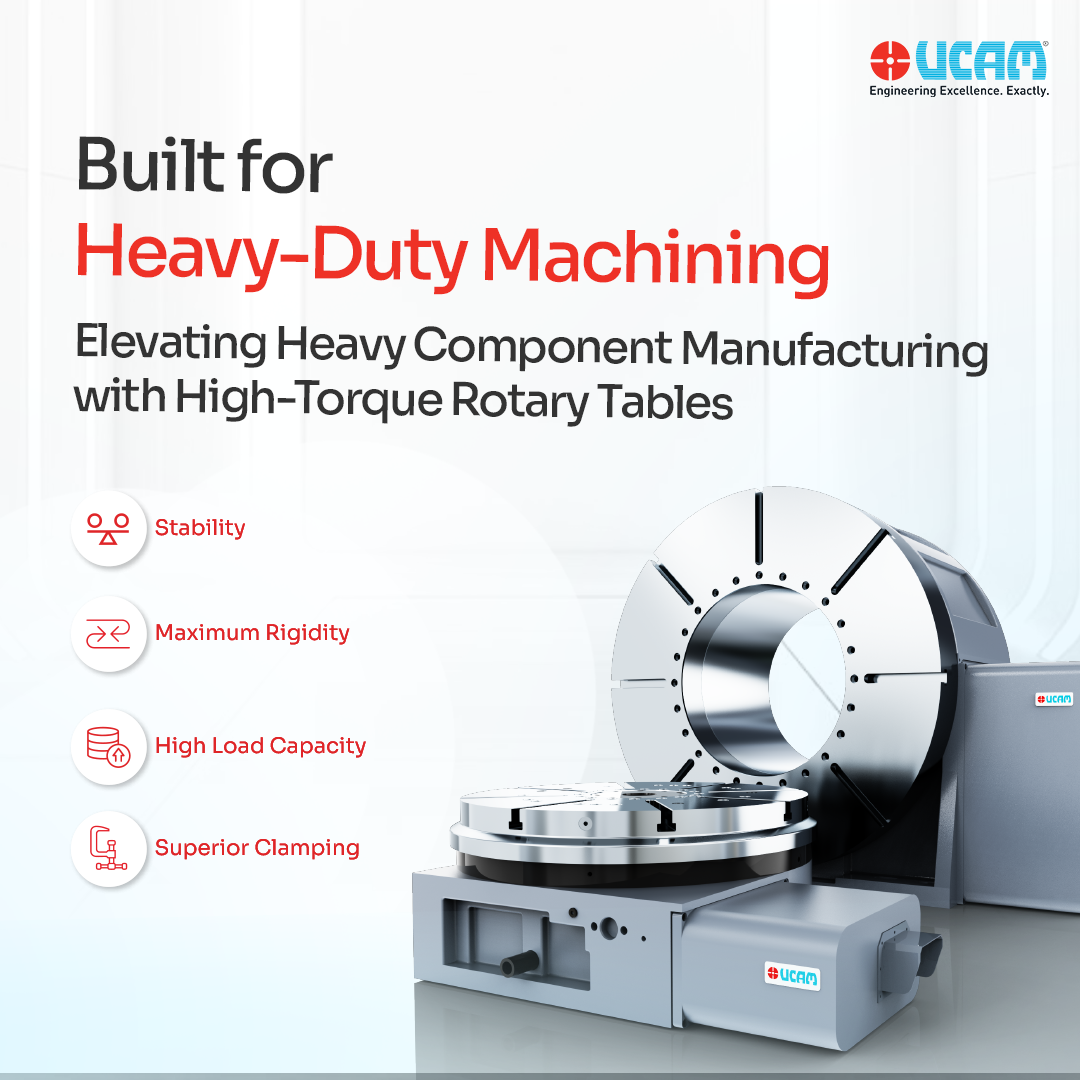
However, transitioning to large-scale component production brings a unique set of shop-floor challenges. Machining massive pump housings, forged steel flow-valves, or earthmoving equipment parts is fundamentally different from standard milling. It requires equipment capable of managing extreme weights and aggressive cutting forces. To successfully take on these mega-parts, facilities are upgrading their VMCs and HMCs with a heavy-duty machining rotary table—a strategic addition that provides the unyielding rigidity needed to handle massive payloads with absolute precision.
The Unique Challenge of Heavy Component Machining
When dealing with oversized components, the raw weight of the metal is only half the battle. The true manufacturing challenge lies in managing eccentric mass and cutting leverage.
Large industrial castings are rarely perfectly symmetrical. When a massive, irregularly shaped part is mounted onto a standard machine, its center of gravity is often far off-center. As the machine spindle drives large indexable face mills or deep-hole boring tools into the metal, it generates immense rotational and downward thrust. If the workholding setup lacks sufficient dynamic stiffness, these forces cause the part to micro-shift or vibrate.
In high-precision manufacturing, this vibration—known as chatter—is destructive. It degrades the surface finish, destroys tight geometric tolerances, and shatters expensive carbide cutting tools. To confidently execute heavy component machining, the workholding must act as an immovable foundation.
The Foundation of Rigidity: High-Torque Rotary Technology
To eliminate vibration and securely manipulate oversized workpieces, standard indexing tables are replaced with purpose-built heavy-duty rotary systems. These advanced units rely on two critical engineering principles to ensure flawless stability under load:
1. Incompressible Hydraulic Clamping
When heavy cutting forces hit a massive part, standard air-based (pneumatic) brakes act like a sponge, allowing the part to flex. Heavy-duty rotary tables utilize high-pressure hydraulic clamping systems. Because hydraulic fluid is physically incompressible, it delivers thousands of Newton-meters of holding torque. This effectively fuses the rotary table in place, transforming it into a solid block of iron that easily absorbs aggressive roughing cuts without flinching.
2. Maximum Payload Distribution
Instead of standard ball bearings, premium heavy-duty tables utilize pre-loaded axial-radial cross-roller bearings. This sophisticated bearing design distributes multi-ton weights and heavy cutting thrust evenly across a massive surface area. This ensures that even when machining a deeply off-center part, the table remains perfectly square and precise, protecting the machine’s internal mechanics from uneven wear.
Strategic Advantages of Heavy-Duty Integration
Adding a high-torque rotary table to a Vertical or Horizontal Machining Center fundamentally upgrades a facility’s operational capabilities, delivering three distinct business advantages:
Streamlined “Done-in-One” Workflow
Without a rotary table, machining a multi-sided heavy casting requires an operator to stop the machine, bring in an overhead crane, unclamp the part, rotate it manually, and meticulously re-align it. This overhead hoisting process can take hours and introduces severe alignment errors. A heavy-duty machining rotary table automates this entire process. The multi-ton part is clamped once, and the table dynamically positions it to expose every necessary angle to the spindle, drastically accelerating factory throughput.
Uncompromising Quality Assurance
OEMs in the energy and heavy infrastructure sectors enforce strict zero-defect policies. By eliminating the need for manual crane-hoisting and repositioning, heavy-duty rotary systems remove human handling errors from the equation. Facilities can guarantee that the massive parts they deliver possess identical, perfect concentricity from the first unit to the last.
Expanding Contract Capabilities
Equipping your shop floor with the right heavy-duty workholding signals to prime contractors that your facility is ready for tier-one projects. Whether it is machining robust drivetrain housings for commercial vehicles or high-pressure valves for regional energy pipelines, possessing the capability to flawlessly execute heavy component machining opens the door to high-margin, long-term manufacturing contracts.
Empowering Production with UCAM Heavy-Duty Solutions
To support manufacturers stepping into the heavy industrial arena, UCAM engineers heavy-duty rotary solutions designed specifically for unyielding performance under extreme payloads.
UCAM’s large-capacity rotary systems—including their dedicated Large Bore series and the URPQ CNC Rotary Production Systems—are built from the ground up for maximum dynamic stiffness. Featuring ultra-high torque hydraulic braking and premium cross-roller bearings, these systems provide the immovable rigidity necessary to machine multi-ton workpieces. By integrating UCAM’s robust technology, facilities can confidently scale up their production, protect their machine tools, and consistently deliver flawless heavy components to the global market.
FAQs
How does a heavy-duty rotary table handle parts that are significantly heavier on one side?
Heavy-duty tables utilize axial-radial cross-roller bearings and robust cast-iron housings specifically designed to manage eccentric (off-center) loads. This bearing design prevents the table from tilting or deflecting under uneven weight, maintaining perfect rotational accuracy even when the workpiece is highly asymmetrical.
Why is hydraulic clamping mandatory for heavy component machining?
When machining massive parts, the cutting tools generate immense leverage and twisting forces. Pneumatic (air) clamping compresses under this stress, leading to tool chatter. Hydraulic fluid is completely incompressible, providing the massive, unyielding locking torque required to hold multi-ton parts perfectly still during aggressive milling.
Does adding a heavy-duty rotary table eliminate the need for overhead cranes during machining?
Yes, during the actual machining cycle. While a crane is still used to initially load the raw casting onto the machine, the rotary table eliminates the need to repeatedly stop production and use the crane to manually flip and re-align the part for multi-sided operations. This creates a highly efficient “Done-in-One” workflow.


 ucam_marketing