
 31 August 2026
 34
34In the highly competitive automobile industry, the pressure to deliver perfectly machined components at high volumes is relentless. Whether a facility is manufacturing for regional heavy-vehicle fleets in the UAE or exporting to global automobile hubs, part quality and production speed must go hand in hand.
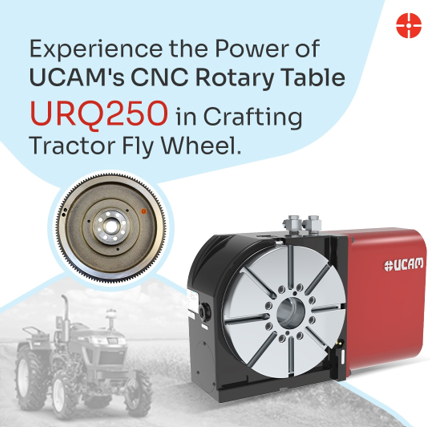
Few automobile components test a machine shop’s efficiency quite like the flywheel. This massive cast-iron disc is critical to a vehicle’s operation—it smooths out power delivery, engages the clutch, and carries the starter gear. Because it rotates at thousands of RPMs, its geometric precision and balance must be flawless. To meet these demands without creating a massive production bottleneck, tier-one manufacturers are abandoning traditional machining methods and integrating 4th axis CNC Rotary Tables to transform how flywheels are produced.
The Bottleneck of Traditional 3-Axis Machining
Machining an automobile flywheel is a multi-step process. The center bore must be perfectly concentric, the friction face must be completely flat, and complex bolt-hole circles must be drilled to attach the clutch assembly and crankshaft. Additionally, the outer diameter (OD) requires radial drilling to insert timing pins or remove precise amounts of metal for dynamic balancing.
When relying on a standard 3-axis Vertical Machining Center (VMC), this process is painfully slow. Because the spindle can only cut straight down (the Z-axis), the operator is forced to manually unclamp the heavy flywheel, rotate it sideways, and re-clamp it in custom fixtures just to access the outer edges.
Every time a multi-ton batch of cast iron is manually hoisted and repositioned:
- Throughput plummets: Non-cutting transition time skyrockets.
- Error compound: Manual re-fixturing introduces “tolerance stack-up,” meaning the perfectly drilled center bore might suddenly be out of alignment with the newly drilled OD holes.
- Labor costs rise: A highly skilled operator is required to manually manage the heavy lifting and repositioning.
The 4th Axis Advantage
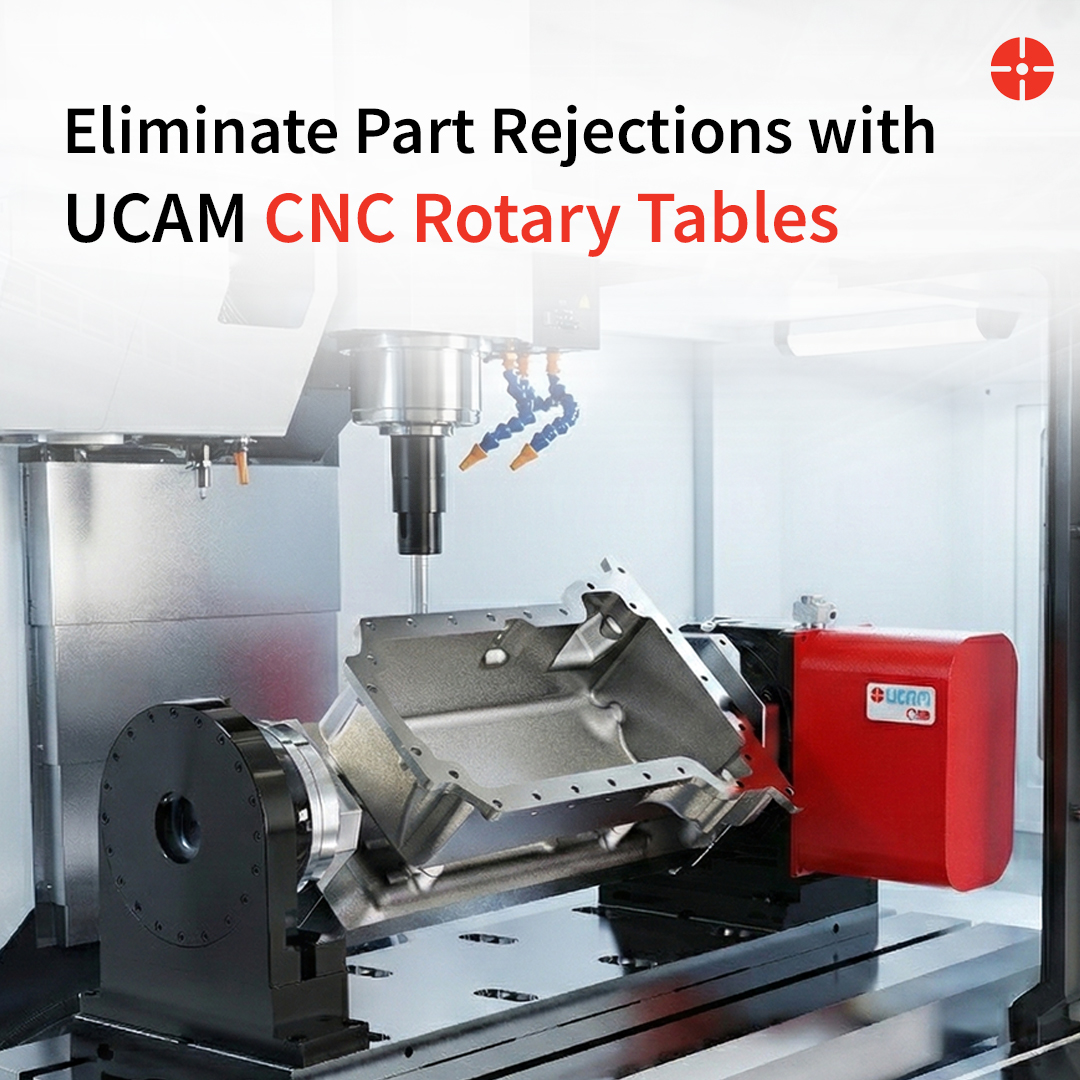
To eliminate these operational bottlenecks, facilities are outfitting their VMCs with robust 4th axis rotary tables, such as the heavy-duty models engineered by UCAM.
By mounting the flywheel to a programmable rotary faceplate, the CNC controller gains the ability to automatically index the part. Instead of the operator manually flipping the heavy disc, the rotary table spins the flywheel to the exact angle required and locks it securely into place.
This creates a seamless, “Done-in-One” machining cycle. The spindle can drill the face, and then the table rotates the part 90 degrees to allow the spindle to drill radial holes straight into the outer diameter—all in a single, automated setup.
Key Manufacturing Benefits for Automobile Production
Integrating a UCAM 4th axis rotary table into an automobile production cell delivers immediate, measurable advantages to the shop floor:
1. Flawless Dynamic Balancing
An unbalanced flywheel will tear an engine apart. Because a rotary table exposes the entire outer circumference of the part to the cutting tool, the CNC machine can automatically drill precise, shallow balancing holes around the OD without the part ever leaving the chuck. This guarantees perfect concentricity between the center bore and the balancing points.
2. High-Torque Rigidity
Flywheels are heavy, and the face-milling tools used to cut them generate extreme radial thrust. High-quality 4th axis tables utilize powerful hydraulic clamping systems. When the table indexes to a new position, incompressible hydraulic fluid locks the faceplate down with massive force. This provides the unyielding rigidity needed to prevent tool chatter, ensuring a mirror-smooth friction surface for the clutch.
3. Drastic Reductions in Cycle Time
By eliminating manual part handling and crane hoists in the middle of a machining cycle, cycle times drop dramatically. Machines run continuously, allowing a single operator to manage multiple VMCs simultaneously. For shops handling high-volume automobile contracts, this exponential increase in productivity is the key to protecting profit margins.
Driving Automobile Manufacturing Forward
Succeeding in the modern automobile supply chain requires eliminating waste at every step of the manufacturing process. The manual handling, custom fixturing, and alignment errors associated with traditional flywheel machining simply cannot keep pace with today’s production quotas.
By upgrading standard VMCs with UCAM 4th Axis Rotary Tables, industrial machine shops can automate part positioning, guarantee flawless rotational balance, and achieve the high-speed “Done-in-One” productivity required to dominate the global automobile sector.
FAQs
Why is single-setup machining so critical for an engine flywheel?
A flywheel is a high-speed rotational mass. Its internal bores and outer balance points must be perfectly concentric to the crankshaft. Unclamping and moving the part to a second machine introduces microscopic alignment errors (tolerance stack-up). At 6,000 RPM, those microscopic errors cause severe engine vibration and premature bearing failure.
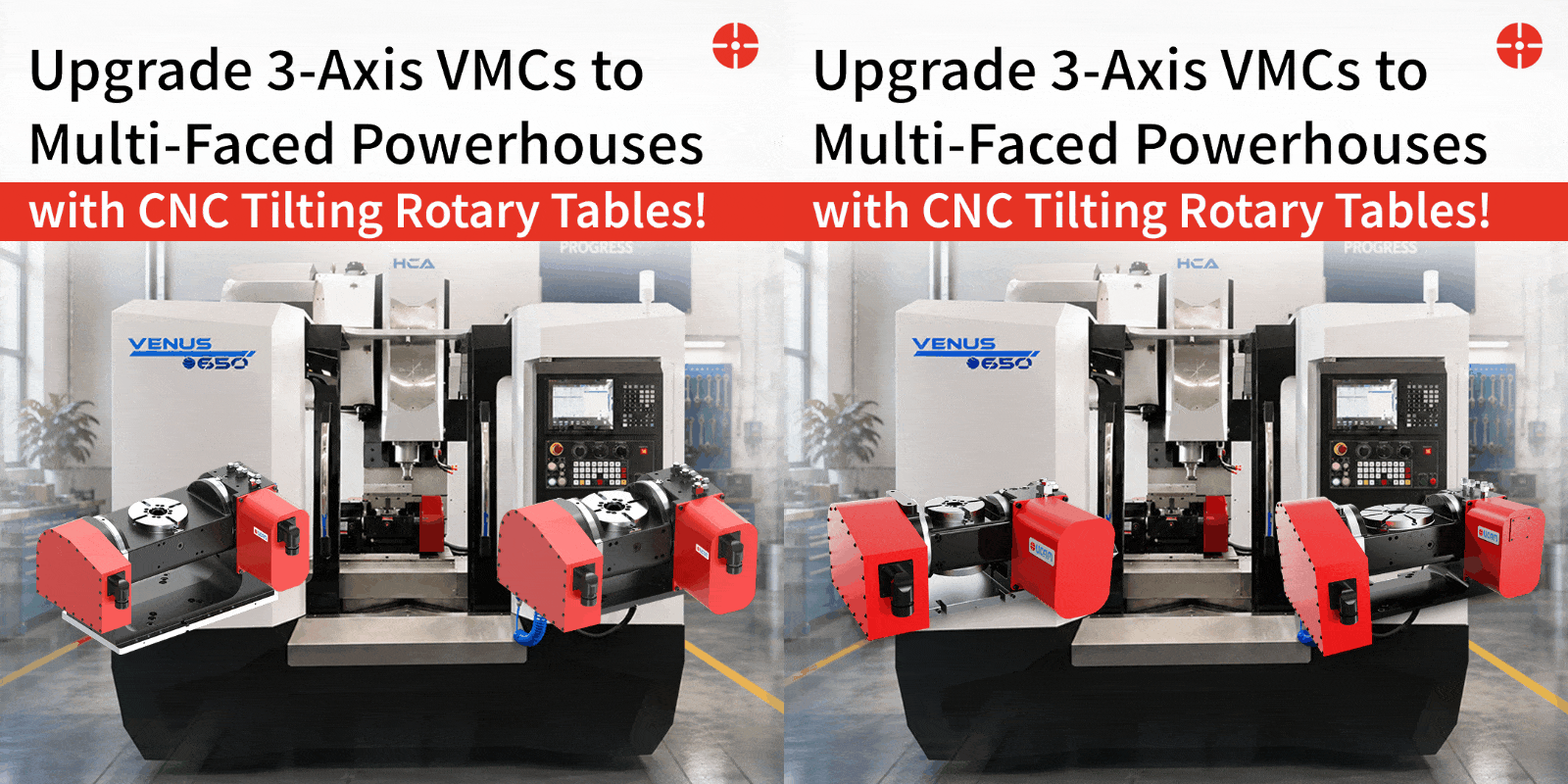
How does a CNC rotary table allow a standard VMC to machine both the face and the outer edge?
A standard 3-axis VMC only cuts straight down. By utilizing a tilting rotary table, the machine can hold the flywheel flat to drill the face, and then automatically tilt the part 90 degrees vertically. This exposes the outer circumference to the overhead spindle, allowing it to drill radial timing holes or balancing points in the exact same setup.
Why is hydraulic clamping required when drilling a heavy flywheel?
When a drill engages heavy cast iron, it generates intense rotational cutting forces. Air-based (pneumatic) clamping is compressible and acts like a sponge under pressure, allowing the part to micro-shift. Hydraulic clamping utilizes incompressible fluid to deliver massive locking torque, effectively fusing the table in place to ensure absolute rigidity and prevent tool breakage.



 ucam_marketing