
 6 July 2026
 1199
1199
Upgrading a machining center with a CNC Rotary table is a strategic investment intended to increase throughput and accelerate production. However, whether you manage a high-volume manufacturing facility in the UAE or oversee industrial operations elsewhere, a common operational oversight persists: rotary workholding is often ignored until component quality visibly degrades. By the time quality control flags a rejected part, the facility has already incurred the costs of wasted raw material, delayed timelines, and potential emergency repairs.
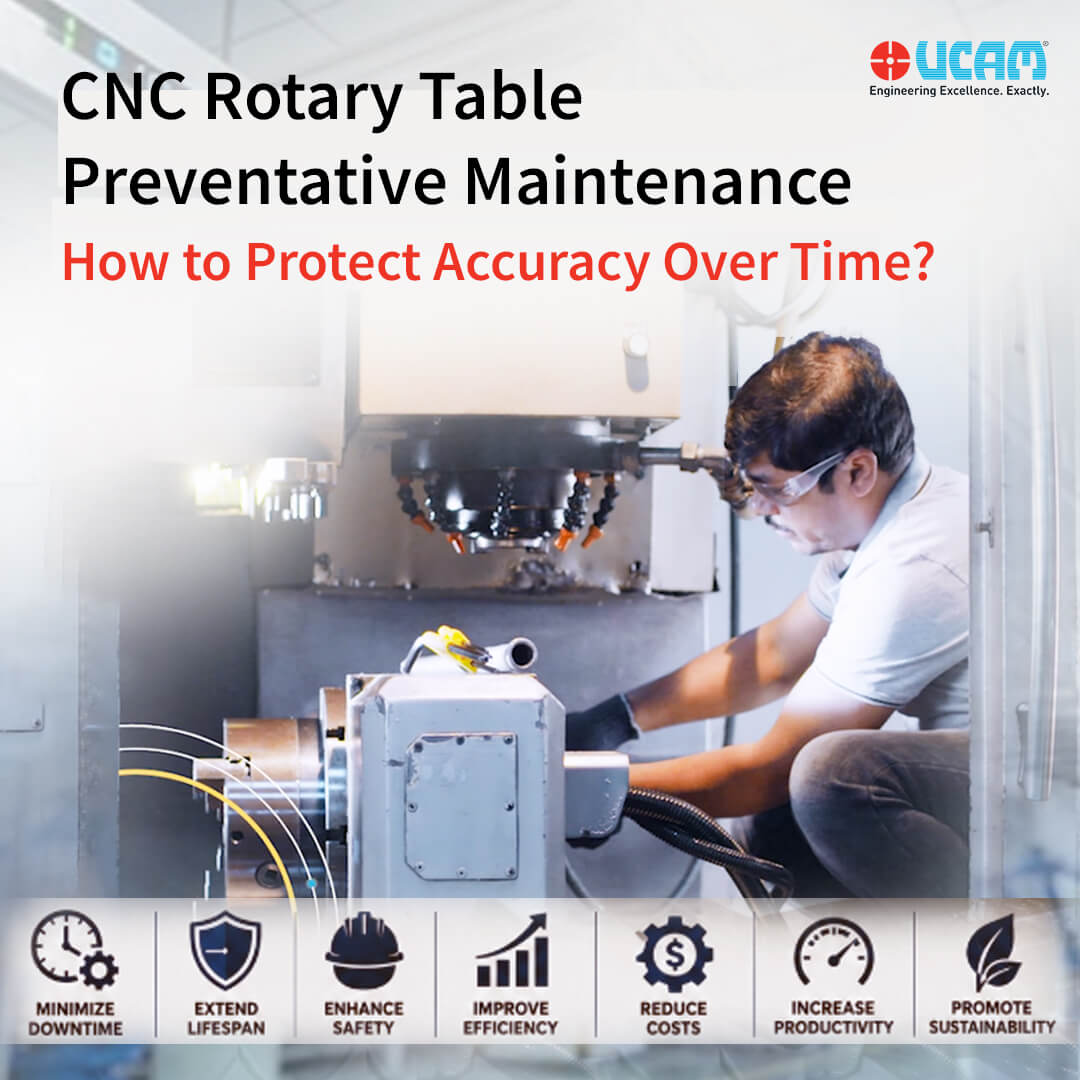
Transitioning from reactive to preventative maintenance is essential. A structured maintenance schedule is a critical operational strategy designed to achieve specific facility goals:
- Minimize Equipment Downtime: Unplanned stops severely impact profitability.
- Extend Equipment Lifespan: Proactive care delays capital replacement costs.
- Enhance Safety: Ensures mechanical, electrical, and hydraulic systems operate securely.
- Improve Efficiency: Maintains consistent machining cycles.
- Reduce Maintenance Costs: Prevents minor wear from escalating into catastrophic failures.
- Increase Productivity: Keeps the machine running at optimal feed rates without chatter.
- Promote Sustainability: Maximizes the lifecycle of industrial assets.
Daily Preventative Maintenance Protocols
The most effective line of defense is the machine operator. The following checks must be executed every day before the first machining cycle.- Check the Lubrication Oil Level: Visually inspect the oil sight glass daily. The gear oil should rest exactly at the designated fill line. If the fluid appears clear, operation can proceed. If the oil is milky or cloudy, stop the machine immediately. Discoloration indicates machine coolant has breached the internal seals and is mixing with the gear oil, which will rapidly destroy internal drive mechanisms.
- Verify Hydraulic Pressure: If the facility uses a heavy duty rotary table to machine rigid materials like steel, it relies on hydraulic brakes to lock the workpiece. Check the pressure gauge to ensure it matches the manufacturer’s manual. Insufficient pressure allows the braking sleeve to flex during heavy cuts, inducing tool chatter.
- Inspect the Hydraulic Power Pack: For hydraulically operated tables, verify the oil level within the standalone booster. A depleted reservoir can introduce air into fluid lines, compromising clamping torque.
- Clean the Rotary Table: At shift’s end, thoroughly clean the table. Never leave wet, abrasive metal chips or pooled alkaline coolants resting on the equipment. Prolonged coolant exposure accelerates the degradation of rubber seals, creating entry points for contamination.
Monthly Preventative Maintenance Protocols
Once a month, the maintenance team should conduct a localized inspection to identify progressive issues.- Listen for Abnormal Noise: A properly functioning 4th axis rotary table operates with a smooth auditory profile. Irregular grinding, clicking, or dragging noises during rotation indicate internal metal-on-metal friction. Investigate immediately before irreversible gear damage occurs.
- Inspect for Oil Leakage: Examine the base of the rotary table and surrounding machine bed for pooling fluid. Unexplained accumulation is a primary indicator of a compromised internal seal.
- Check for Coolant Entry: Inspect breather valves, motor covers, and cable connection points. If coolant penetrates the motor housing, it will short-circuit the servo motor and rotary encoders, resulting in immediate faults.
- Verify Oil Levels: Cross-reference daily sight glass checks to ensure the oil level has not slowly depleted over the preceding four weeks.
Bi-Annual and Annual Preventative Maintenance Protocols
These intensive procedures protect the sub-micron capabilities of a precision rotary table. Adhering to this schedule prevents the highly expensive process of ordering and replacing internal rotary table parts under emergency conditions.- Check and Correct Backlash (Half-Yearly): Friction between gears causes natural wear, creating a microscopic mechanical clearance known as backlash. When the table reverses direction, this gap causes the workpiece to be fractionally out of position. Maintenance personnel must measure this clearance using a precision dial indicator every six months. If play is detected, the internal worm gear must be mechanically adjusted to close the gap, restoring factory-level accuracy.
- Check the Oil Filling Plug Seal (Annually): Examine the rubber seal beneath the oil filling plug annually. If the rubber exhibits signs of hardening or cracking, replace it immediately to prevent coolant from flooding the gearbox.
- Inspect Conduits and Cables (Annually): Power and encoder cables flex continuously as the machine’s linear axes move. Repetitive motion can cause protective outer conduits to crack. Inspect all cables thoroughly and replace them if they appear fatigued to prevent coolant from reaching internal wiring.
- Lubrication Oil Replacement (Annually): Gear oil must be completely drained once a year. Over time, oil accumulates microscopic metal particulates from natural wear. Flush the system and refill it exclusively with the manufacturer’s specified grade of fresh lubrication oil.
- Test for Smooth Running (Annually): Following oil replacement and backlash adjustments, command the table through rapid, 360-degree rotations in both directions. This final validation ensures motion is fluid, braking is immediate, and the equipment is prepared for another year of high-precision manufacturing.
Conclusion
Treating your rotary equipment with the same strict care as your main machine spindle is the only way to ensure long-term profitability. By taking a proactive stance on fluid management, mechanical adjustments, and contamination control, you guarantee that your setup will continue to deliver flawless parts and protect your bottom line for years to come.FAQs
What indicates coolant ingress in a CNC rotary table, and what is the required action?
Coolant ingress is indicated when gear oil in the sight glass appears milky or emulsified. If observed, halt operations immediately, drain the fluid, flush the gearbox, and replace compromised seals to prevent catastrophic internal corrosion and bearing failure.
What causes a loss of indexing accuracy over time, and how is it corrected?
The primary cause is mechanical backlash—a microscopic clearance between gear teeth resulting from continuous operational wear. This is corrected through bi-annual dial indicator inspections and mechanically adjusting the worm gear assembly to eliminate the clearance and restore factory precision.
What causes workpiece chatter during heavy milling on a rotary table?
Chatter is predominantly caused by insufficient clamping torque. If hydraulic or pneumatic pressure falls below manufacturer specifications, the braking mechanism cannot secure the platter rigidly. To resolve this, verify and restore the system pressure to eliminate micro-vibrations and tool deflection.



 ucam_marketing